Sit, Sip, ‘n Scroll: 25 Years of Agency Learnings
To mark my 25th anniversary in the advertising industry, I wrote a series of LinkedIn posts called “Sit, Sip, ‘n Scroll Sundays.” Here are some agency learnings from my 25 years in the business.
2025 marked my 25th year in advertising (where did the time go!) and so I wanted to share some agency learnings.
I cut my teeth in the early years at Cossette and BBDO, with my formative years as SVP, CD at OneMethod. And now, I’ve spent the past almost seven years as SVP, ECD, & Partner at FUSE Create, building an ever-evolving, and pretty special, agency.
To mark my 25th anniversary, I wrote a series of LinkedIn posts starting on January 19th of last year called “Sit, Sip, ‘n Scroll Sundays.” Every other Sunday, I’d share agency learnings and agency life advice that has helped build brands, build careers, and build agencies.
So, whether you’re reading this on a Sunday or on a Thursday, put the coffee on and pull up a couch, and I hope this year-long collection of career-long musings will help you in your career, and find it’s way into your own agency life…🛋️☕️🧠
No. 1: Job vs. Career Mindset.
We’ve all had jobs before. Part-time jobs. Summer jobs. Jobs we took on because our parents said, “Get a job!” Even jobs we mired in until the right one came along (I certainly did). But once we do find our vocational calling, we have a choice to make; do we continue to behave like it’s a ‘job’? Or do we treat it like a career?
It’s two different mindsets with two very different outcomes. And I’ve seen both play out: those focused on what they get out vs. what they put in; those defined by their role vs. those who define it; and as Jon Crowley once put it, those who ‘wanna go home at 4pm’ vs. those who want to win a Cannes Lion.
Jobs build resumes. Careers build reputation. Experience. Expertise. Foundation. Longevity. It’s all about attitude, where you show up, speak up, sometimes have to shut up, always put your hand up, and some nights, stay up. We all have a job to do, but it’s our mindset that defines how we do it, and why.
No. 2: Not everything is black and white.
That’s true in life, and imperative in an agency. Being flexible in our processes and decision-making infuses a sense of adaptability in the work we do. Where budgets, workbacks, and even client asks, become uncharacteristically lenient. Where roles like Project Management aren’t painted with strokes of black and white. If we think in absolutisms, we can miss opportunities, or even worse, lose a client (something I witnessed firsthand). A creative culture thrives in the grey.🩶
It feeds off the new, the unexpected, and the unknown, because creativity isn’t black and white. A ‘roll with the punches’ attitude allows for flexibility in a media plan, a production, a timeline, and in ourselves, with additional agency learnings along the way. With that, we have the appetite to pivot on an idea and the willingness to change on a dime, because technology, competitors, and even the weather, can change in an instant. To take advantage of the unforeseen, we all need to be ok with a little grey (yes, even those PMs).
A creative team might come up with a better concept the day before a pitch. A strategist might uncover a new and more relevant insight after the brief’s been approved. Or TikTok might release a new conversion unit in the middle of a campaign. The grey offers solutions in support of the work and the client; they say yes first and ask questions later.
No. 3: Take the work seriously, not yourself.
Contrary to what friends and family might believe when they pitch us their taglines and commercial ideas, advertising ain’t easy. Being unassumingly persuasive is hard work. And there’s a lot at stake; money, job security, brand reputation, even your reputation. So, we ought to take the work seriously.
The kind of work that has high expectations on every post, campaign, timeline, pitch, and media plan we create. And all that award-winning expectation and KPI-shattering pressure, can be utterly stressful.
But just remember; while the problem might be serious, the moment doesn’t have to be.
Keep things light. Keep things positive. By not taking yourself too seriously, it’ll keep things in perspective, and anxiety in check. I think it was Bruce Springsteen who said, “Stress, what is it good for? Absolutely nothing.” – and hey, he’s the boss!
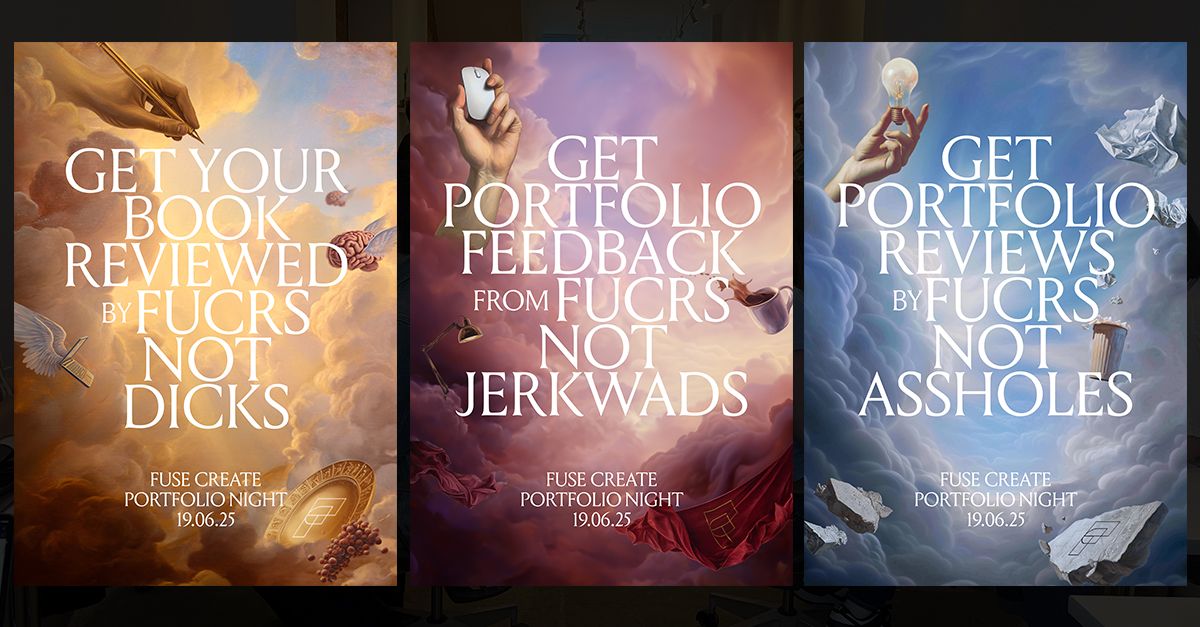
Also, this is advertising! We can’t create flying moustaches, singing Seal seals, or clones of Nate Bargatze, without a little levity. So, in this cut-throat world of advertising, cut the tension with a smile, like we tried to do with our Portfolio Night posters.
No. 4: The balancing act of work and life.
An interview question I hear a lot is “What’s the work-life balance at your agency?” Which I get, we all need balance in our lives, a state of equilibrium in our chi. But I find there’s something about Advertising where ‘work’ and ‘life’ aren’t so mutually exclusive.
One tends to get into Advertising because they love it – in fact, it can often feel more like a hobby than ‘work’! It’s also a discipline that’s hard to switch off; ideas come at any time, timelines can be tight, and it’s a highly competitive industry.
So for me, rather than seeking a work-life balance, I create a work-life integration.
Where it’s not one or the other – it’s not work or life – but integrating the two in a way that’s gratifying and sustainable and one of my main agency learnings. Dovetailing the always-on work demands with what I demand out of life, so neither feel burdensome or taxing but rather, fulfilling and rewarding.
A work-life integration accepts that one’s work is a part of life, not apart from it.
No. 5: Leave your ego at the door.
Culture is the lifeblood of an agency. It’s a catalyst for retention, the source of award-winning work, and the glue that is camaraderie (our Creative duo Maddy & Lia know a little something about that!). My approach to building agency culture has always been people-first, where the agency feels more like a family than a staff. A culture that inspires, supports, champions, and nurtures—and leaves egos at the door.
Confidence is a must in this business. You need a thick skin, and you need to believe in yourself and your convictions to get the most head-turning ideas through. But you don’t need to do it with an air of egotism. Ego thwarts collaboration, breeds unhealthy competition, and weakens the bonds of camaraderie; ego is just conceit trying to pass itself off as confidence.
View this post on Instagram
No. 6: Don’t just make your clients happy.
It’s easy to make your clients happy. You just give them what they want. But we shouldn’t just try to make our clients happy; we should make them look like heroes. And that takes hard work because what they want, isn’t always what they need.
So, we might have to interrogate their ask rather than simply accept it. Or push back on timelines, budget, and feedback. Or even educate clients on what great work looks like. And all of that takes time, effort, critical thinking, persistence, ingenuity, patience, bravery, and the occasional difficult conversation – and all of that ain’t easy. But as Teddy Roosevelt said, “Nothing in the world is worth having or worth doing unless it means effort…” Hear hear Teddy.
The path of least resistance leads to mediocrity, contentment, and a minimum viable creative product – it ekes out client happiness. Instead, forge a new path, one that leads to client promotions, overwhelming pride, and award-winning creative, and come EOD Monday, clients that look like heroes.
No. 7: The work’s gotta work.
An industry cliché sure, but just because it’s commonplace, doesn’t mean it’s out of place
Clients come to agencies for creative solutions to their marketing problems. Be it an awareness issue, a perception change, or to drive an action, it’s our job to uncover a human and/or product truth, and message that truth in the most compelling and break through way – it’s literally our job.
So, the work’s gotta work. It has to deliver on our clients’ briefs and over-deliver on their KPIs otherwise, why come back? That should be the goal, not awards. Now wait, before you scroll past this post in disgust, hear me out…
Awards are an eventuality of work that works because, more often than not, great results emerge from great work. And from what I’ve seen, when you blow the KPIs out of the water, you’re likely to blow the socks off some judges too. 💥🧦
No. 8: Three empty bullet points, full of possibility.
Most roles are outlined in a job description, often as a set of bullet-appointed duties and responsibilities. A seemingly finite list of expected functions and tasks that have a beginning, a middle, and most egregiously, an end, because what we contribute to an organization is never finite.
That’s why at the end of every job description; I like to leave three empty bullet points. It’s shorthand for ‘wear whatever hat you want!’, and it signals an open invitation to contribute in any way possible, within your role or outside it. A simple addition to any job description that at first glance might look like a mistake, but there’s no mistaking the growth, motivation, and opportunity it can lead to in an employee.
Those three vacant bullet points are there to empower and inspire; each a little black oyster to a world of possibilities, or at the very least, a Monday of possibilities…
No. 9: Own your work.
My father used to say if I had to sweep the floor, I should make it the cleanest floor anyone had ever walked across. Or if I had to mow the lawn, make it the envy of golf course groundskeepers.
He believed any job you take on, no matter how big or small, you should give your absolute best. Not because you might get in trouble or need to do it over again, but because it was a reflection on you.
At the office, if you approach your work like it’s your name on the door (and not the agency’s), you’ll work differently. You’ll spend a little more time finessing that layout, crafting that copy, or reviewing those animations in the presentation, because it’s yours, not ‘theirs.’ You’ll have a stronger sense of ownership, and with it, accountability, responsibility, and, most importantly, pride.
When everyone ‘owns’ their work, trust grows, the work improves, and the agency thrives. So come Tuesday morning, give that case board a little extra love. Review that all-agency email just one more time. And double check that TEAMS background before the call. And if you happen to be mowing a lawn, mow the hell out of it!
No. 10: When it comes to interns, attitude trumps skill.
I’ve seen a lot of interns come through the agency over the years. And the ones that end up graduating from intern to Account Coordinator or Junior Copywriter have this in common: their attitude earned them the spot, not their skills.
Let’s be clear, I’m not talking about organizational skills or having great attention to detail (both good things mind you.) I simply mean, at the intern or junior level, you don’t know what you don’t know. And frankly, how could you? Learning the craft, skills, processes, and practices of your role comes with time and experience. So that leaves you with your attitude; how you show up, the effort you put in, and how you ingratiate yourself into the culture of the agency.
No. 11: A creative-driven mindset vs. a profit-driven one.
I’ve been lucky enough to have had a hand in shaping two successful agencies. Ones not driven by profit but rather, creative-driven, which might seem counterintuitive for business success, but when your product is ‘creative’, that has to be number one.
If profit is #1, then theoretically, everything else is #2, including award-winning work, and the motivation to create it. In a profit-driven organization, decisions are made through an economic lens. Parsimonious choices that affect an agency’s value system and leak into the lexicon of its culture; Functionality, Efficiency and Productivity become the consideration set over Creativity, Inspiration, and Innovation.
Those economically motivated values permeate an agency and all its touch points, from something as simple as uninspired décor to something as pivotal as scrimping on hours needed to produce great work. It affects the clients you go after, seeking those that reflect positively on the balance sheet rather than the brief. Clients that build your bottom line rather than your agency’s portfolio, reputation, and credibility. It rewards short-term thinking for efficiency, versus long-term brand building for effectiveness.
Don’t get me wrong, a creative-driven agency still has to make a profit; they’re just not driven by it, two very different things. Making a profit is the by-product of something else, secondary to the thing you do.
No. 12: Account people, get your clients to love you.
Account people are the agency’s gatekeepers. They hold the key to great work because they often hold the strongest relationship with the client.
It’s the Account lead the client calls first with an ask, an update, or an issue. Yes, members of the creative team and senior management also forge relationships, but it’s the Account lead who, well, leads the account.
With more and more clients procuring a roster of agencies, you want to be the agency they call. And to put it plainly, they’ll call the agency they love – or more pointedly, the Account lead they love. That’s why, whenever I’m asked by up-and-coming Account peeps how to succeed in their role, I always say; get your clients to love you.
They might love you because you’re smart, fast, thoughtful, or fun. Because you feed them great category insights, or simply great dinners. Whatever the reason, if they love you, they’ll turn to you. They’ll trust you. They’ll lean on you as their right-hand. And they’ll call you, first.
So, come Monday morning, for all you Account leads, get your clients to love you. Besides, four mop-tops from Liverpool can’t be wrong, right?! All you need is love. ❤️
No. 13: At heart of a great presentation, is storytelling.
My father was a great storyteller. He’d have us captivated around the dinner table each night, hanging on his every word. At the time, I didn’t know how he did it. Of course, now I know exactly how; he used pauses, eye contact, and tonal dynamics in his delivery. I’m sure he didn’t do it consciously; he just did it – he just told stories.
Being a great presenter is an invaluable skill at any agency, and in any career. You don’t have to love presenting, but if you can be good at it when called upon, it’s a huge asset. And since a great presentation is really just great storytelling, check out this blog post on how to tell a great story.
No. 14: Give your two cents before giving your two weeks.
There is nothing more frustrating than losing good people, especially when a resignation comes out of the blue, and you might have been able to help them stay. That’s why I always tell my teams “I’d rather you give me your two cents than your two weeks.”
I’d much rather hear that an employee is unhappy or getting that seven-year itch then hear they’re leaving. In that way, I can try and intervene, come up with solutions, advocate for their wants and needs (within or outside the agency), and lend an ear to try and understand their situation before any decisions are made; leaders need to be listeners and advocates for their employees.
And employees need to feel like they can cash in on their two cents. They should never feel like their job is at stake by going to their manager/boss to say they feel unfulfilled. Give them the counsel they need and make them feel safe, supported and respected through the process – they’re only trying to make them, their job, and their performance better.
No. 15: Keep subjectivity out of creative decision-making.
Advertising is a funny discipline. It’s inherently creative – that goes without saying – but it is, after all, a discipline, there’s a particular learned skill to it all.
During the creative process, recommendations are made based on experience and other inputs, regarding scripts, casting, music, wardrobe, colour, etc., that all contribute to the efficacy of the creative. What one may not realize, is that they’re strategic decisions, not ‘creative’ ones; objective reasoning versus subjective preferences.
When subjectivity makes its way into decision-making, personal opinion begins to blur those strategic recommendations. And in advertising, personal opinion doesn’t matter; what matters is your audience, your channel, your brand – you get the idea. Bias and emotion smother the skill and understanding inherent in the calculated choices we make as advertisers.
To help keep subjectivity, and its lack of materiality, check out this blog post with tips I’ve found to be effective.
No. 16: “I just want you to manage my expectations.” – any client.
Early in my career, we were in the final stages of a campaign launch and, as these things sometimes go, the campaign site was going to be late. Unfortunately, in addition to the site being late, we were late in delivering the news to the client, who was justifiably disappointed.
But interestingly enough, his disappoint wasn’t so much in the site launching late, but in us not letting him know earlier. Had he known, solutions could have been discussed, budgets could have been reallocated, and he could have had more time to prepare his own boss for the bad news – we didn’t set him up for success. At the end of the call, he said something that has stayed with me ever since; “I just want you to manage my expectations.”
That’s the best and simplest advice I’ve heard for managing client relations – or really any relationship where one relies on another; client/account director, manager/staff, production/creative, teacher/student, etc. That way, there are no surprises. And “bad news” instead becomes an update, with lots of time to respond rationally and with stress-free next steps.
No. 17: Why do we sell the Shortlist short?
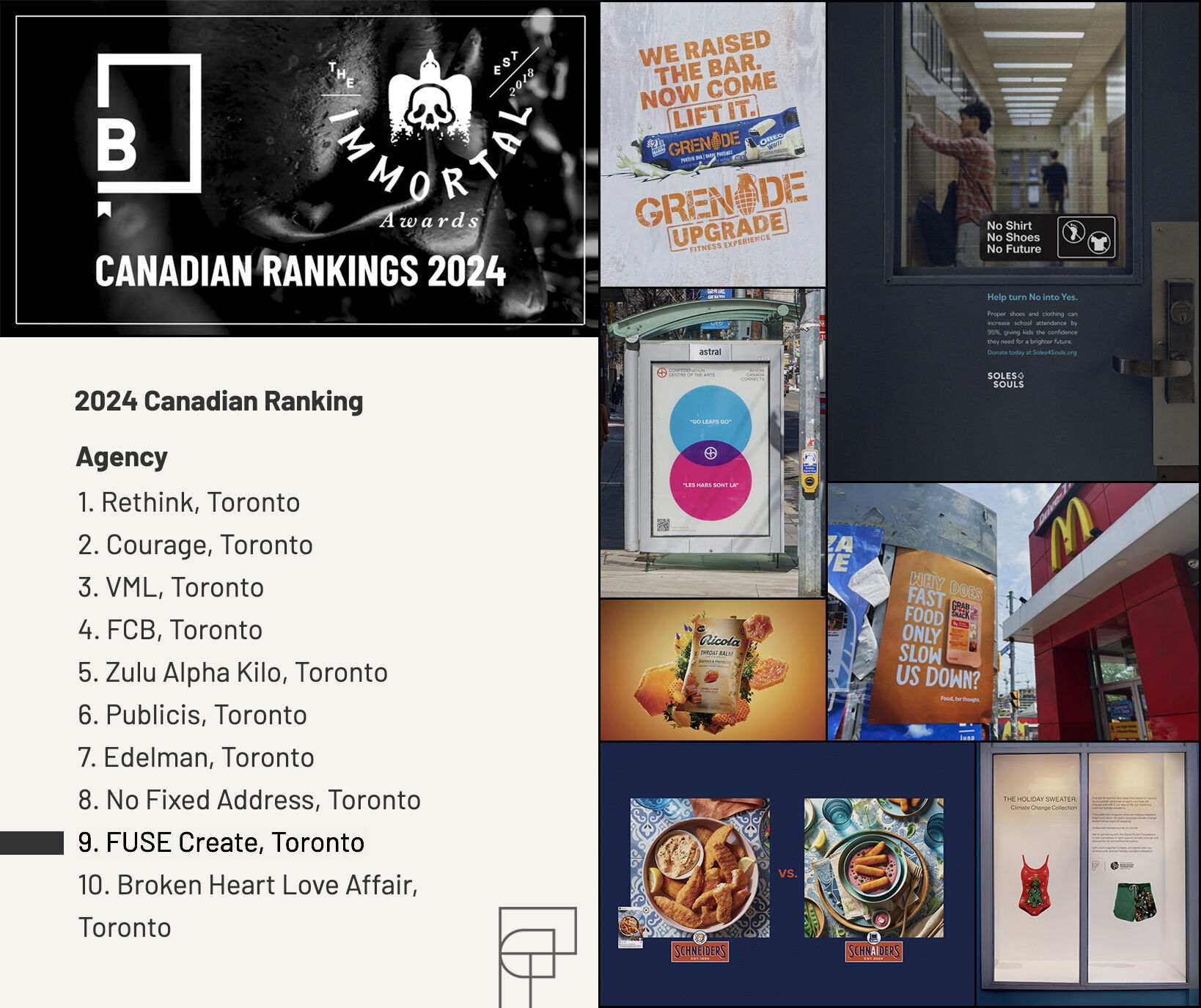
When it comes to awards, there’s a common theme in advertising; making the Shortlist isn’t good enough. Why is that? Don’t get me wrong, Gold is what we all want, but getting your work in the running in the first place, against stiff competition and against all odds, isn’t that a win too?
A couple of years ago we were shortlisted at Cannes. At dinner the night before the results were announced, someone asked if anyone had any work Shortlisted, I mentioned we did. The table erupted; “Congratulations!”, “What an incredible achievement!”, “You must be so proud!” Their effusive response reminded me that indeed, we were in select company. That out of 1600 entries from around the world, we were in the top 10%, and that’s not nothing.
So, come Monday morning (or perhaps Monday evening), join me in raising a glass of rosé, to all the great work and great agencies that do make the Shortlist, because not everyone does.
View this post on Instagram
No. 18: Onboard Juniors from the office, not from home.
Working from home has its advantages. But in certain situations, it can be detrimental to do so, such as the onboarding of Junior hires.
Giving that fresh-out-of-school hire the best chance to succeed at your agency means getting them and their manager into the office on a regular basis in the first few weeks of their tenure. There are nuances to agency culture, interdependent relationships, and personality subtleties that you simply cannot glean while working from home. Entrenched agency rituals, customs, and expectations are better learned, and better ingrained, when you interact with people face-to-face, rather than screen-to-screen.
Starting your first job can feel like being a fish out of water. But coming in just two to three times a week, say for the first month, can help those Juniors feel right at home instead. As employers, we owe it to our new recruits, to build trust, camaraderie, and confidence in the work environment.
So, come Monday morning, help your recently hired Junior go from green to gold by setting up weekly visits to the office, because while your work-from-home policy might have attracted them to your agency, it’ll be your work-from-office onboarding that gives them the greatest chance of succeeding there.
No. 19: A Possibilitarian culture.
Culture is the lifeblood of an agency. But when I say “culture”, I don’t mean beer carts and brightly painted walls. I’m mean the literal definition of the term; attitudes and behaviour characteristics of a particular social group. Culture is nothing without the people who bring the right attitude and who embody the right behaviours. And the best kind of people IMO, are Possibilitarians.
It’s not my word (hats off to Dr. Norman Vincent Peale), but it’s my favourite word to describe the kind of person an agency culture thrives under.
A Possibilitarian is someone who is equal parts positive-attitude and believer that everything is possible. They pour their glass half-full, and grey is their favourite colour because for them, nothing is black and white. They are natural collaborators, ardent champions, infectiously optimistic, and leave their ego at the door. They don’t point fingers and they’re steadfast naysayers of the response “no” and “can’t”. They also make work well, feel a little less like work.
No. 20: Great work begets more work.
There are several ways to drive new business for an agency. There are ‘Push’ strategies such as Sales, but they’re often hit and miss, as cold calls and email blasts can fall on deaf ears. ‘Pull’ strategies like PR work well to build an agency’s reputation but can take time to produce results. There is however one foolproof method of driving new business: producing great work.
Great work fuels the ‘pull’ strategy. It strengthens your portfolio, the very thing agencies hang their hat on, and therefore strengthens your case studies and position when pitching new business. And it drives organic growth; growth within your current clients’ remit but more importantly, it opens the door to new channels and broader scopes by building trust, achieved of course, through great work.
No. 21: A defining culture for the Jays, and an agency.
After 32 years, the Blue Jays made it back to the World Series – just one play away from winning it all. They got there on talent, skill, and individual effort, but they also got there, and perhaps more consequential, because of their team’s culture.
When you hear broadcasters, coaches, and even the players talk about the 2025 Blue Jays, a common theme emerges; team chemistry and a certain vibe. An intangible quality that felt unique to the Jays, and instrumental to the success they had this year – and they’re not wrong.
In fact, the same words and phrases used to describe the Jay’s clubhouse this year, are the very ones I’ve been using for the past 20 years in my agency learnings to build agencies that have that chemistry, that vibe. Words like camaraderie, unity, trust, friendship, and family. Phrases like ‘No egos’, ‘Positive energy’, ‘Contagious belief’, ‘Knowing your role and supporting others’, and how winning becomes a by-product of those very intangibles.
No. 22: Do great work, with great people, for great people.
After years of watching people come and go from agencies, in search of a better situation or presumably, a happier one, I’ve developed a credo for myself. A simple phrase that best ensures my own happiness at an agency: Do great work, with great people, for great people – I’ve found if I can just do that, I’m happy.
“Do great work” means work that fills you with pride. Work that’s portfolio-worthy, if not fridge-worthy. Work that blows KPIs out of the water, and parenthetically, the socks off judges. And work that makes clients, your team, and your agency look like heroes. If I can do that, I’m happy.
“With great people” speaks to one’s colleagues. The great ones are collaborative, humble, positive, and have your back. They stand shoulder-to-shoulder, even in moments when you don’t see eye-to-eye. And colloquially speaking, they’re just good peeps. If I can surround myself with those types of people, I’m happy.
“For great people” are your clients. Clients who treat you like a partner, not a vendor. Who trust their agency implicitly, and value breakthrough creative, almost as much as their agency. Clients who can take their client hat off, and who are equal parts challenging and forgiving. If I can partner with that type of client, I’m happy.
Achieving that personal credo takes constant evaluation and daily gut-checks. It takes individual effort but also, an agency that supports that mindset… Come Monday morning, what simple phrase or belief do you use as a barometer of your own agency happiness?
No. 23: Two heads are better than one.
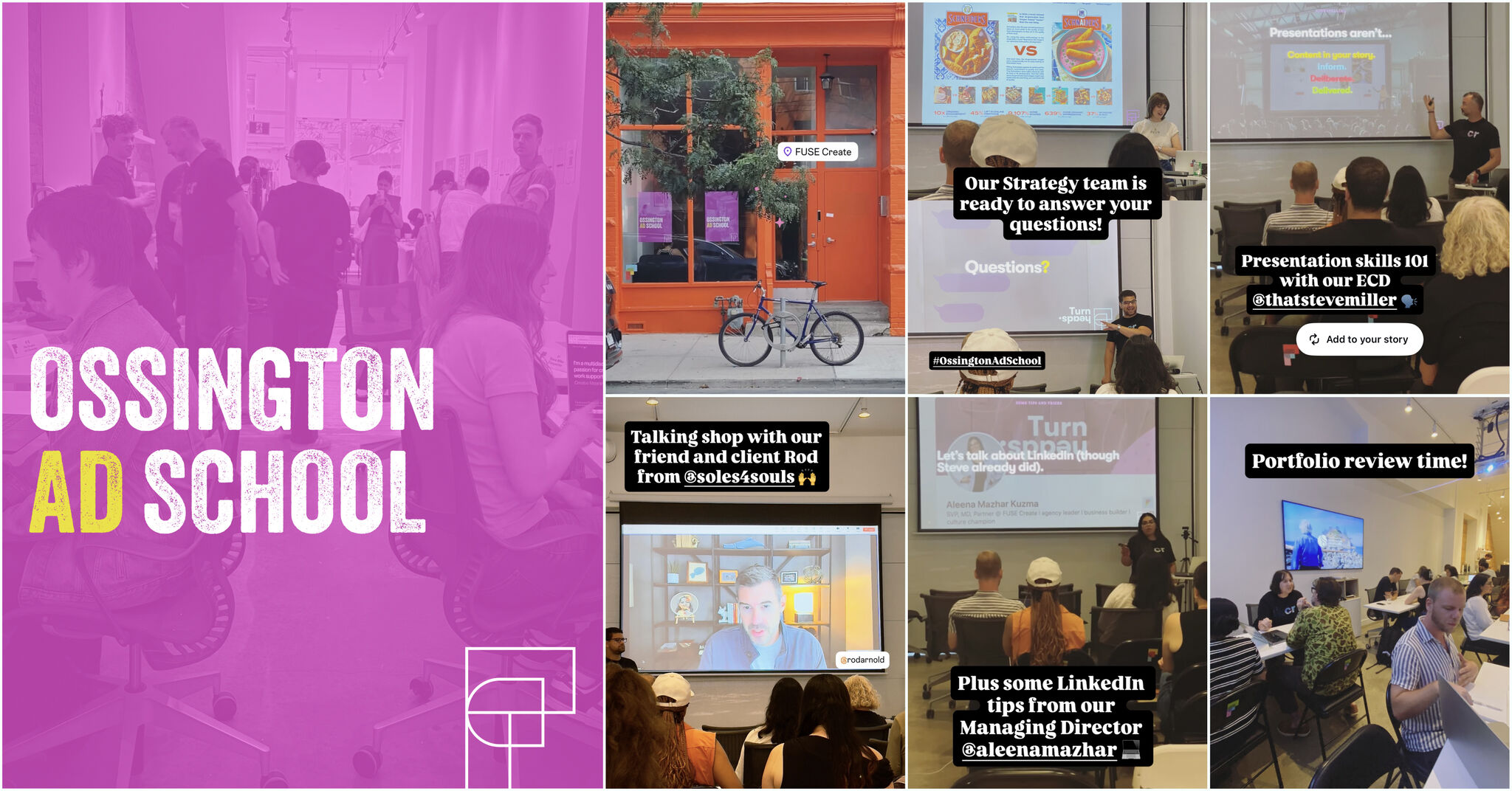
The math doesn’t lie; two heads are better than one (or multiple heads as we tried to include in our Ossington Ad School bootcamp). That adage doesn’t only apply to smarts; it applies to the quality of work and the camaraderie an agency feels when you collaborate. Collaboration builds connection, unity, a team mentality, and a family, not just an agency. You may even get the work done in half the time (as they say, many hands make light work).
If we think of our contribution to an agency as 51% in our title and 49% in any other way we can contribute, collaboration becomes even more influential on a culture and the work. Collaboration also makes sharing in the successes a little sweeter, and commiserating in the failures, a little less painful. And that collaboration ethos extends well beyond the agency. It reframes how you work with developers, production houses, illustrators, or designers, collaborate with them, by treat them like a partner, not vendor.
No. 24: All boats rise with the tide.
After the great fire in London, 1666, the famous architect Christopher Wren was commissioned to rebuild St Paul’s Cathedral. During the rebuild, he observed three bricklayers on the jobsite. He asked each bricklayer, “What are you doing?” The first replied, “I’m laying bricks.” The second said, “I’m earning a living.” The third bricklayer paused and said, “I’m building a cathedral.”
I love this allegory. It perfectly embodies the mindset and perspective we all need in an independent agency. The idea that the focus should be on the greater goal, the collective goal of the agency. With everyone rowing in the same direction, singing from the same hymn book. Because if one person is off, the paddling gets tougher and the hymn sounds way out of tune.
The problem is this; selfishness only buys into you, whereas selflessness buys into something greater than yourself; it buys into you, your colleagues, your agency, and its vision. Ladder climbing takes the focus away from the heights with which you can climb by means of the agency: everyone’s resume will build itself, when everyone is looking down from the top.
Removing personal agenda doesn’t result in the purging of mentorship or career growth – that’s still present and important. It simply means right-sizing priorities from how will ‘I’ benefit, to how will ‘we all’ benefit, because when the agency is successful, so too will you be.
So, come Monday morning, take a second and ask yourself; what are you building?