
AI has a new audience – and we need to market to it.
AI will shape the information & choices that people depend on every day. Therefore, we’ve got to at least consider marketing to the machines.

The biggest thing happening in advertising isn’t what you think.
For the first time ever, your brand has a non-human audience.
This is the biggest shift in our industry since holding companies split media and creative. Therefore, we’re at risk of making an equally short-sighted mistake. Most of the conversation is stuck on budgets, efficiency, and staffing. Yet the real risk isn’t AI taking our jobs—it’s making our work irrelevant.
Over time, AI will shape the information that more and more people depend on every day. It could easily become the most powerful decision-making influence for the next generation. Therefore, we’ve got to at least consider marketing to the machines.

A screenshot from a recent Field Trip hosted by Jon Crowley.
Reinventing Strategy
Everything we’ve ever done to develop a communications strategy is probably obsolete.
We’ve built all of these things on a semi-linear understanding of storytelling. The idea of an exclusively human lens on retention and motivations, and that it’s all inherently somewhat temporary. But when there’s a handful of all-knowing, all-remembering models that are interacting with a growing segment of the world, the stakes are little bit higher.
We’re training non-human systems on information built for humans, and it feels a lot like expecting someone who has just learned English to be fluent in the “small talk” language of your office, right away.
Share of Training Data
Share of Voice has always been valuable. Your presence in a category drives sales, awareness, and brand perception. But as audiences (and AI systems) are constantly trained on fresh data scraped from the internet, Share of Training Data may become just as critical. Since there’s no public index of what goes into training, the best assumption is that the more quality content your brand puts out, the more likely it is to appear in training sets. This mean, the more “top of model” your brand becomes.
This doesn’t mean having the world’s largest website, but it DOES mean thought leadership, white papers, newsletter signups, and valuable branded research now have a secondary purpose. What ways can you create valuable training data that is both neutral, trustworthy, and brand supportive? This doesn’t need to be a separate marketing activity altogether, but something to consider in tandem.
Rethinking Long Form
The attention span problem isn’t a problem anymore. Or at least it won’t be for long.
Many people I know are already turning to AI habitually to get the summary of reports or essays they don’t have the time (or inclination) to actually read. A few are even using AI to distill and transcribe the key points of video content.
Suddenly, long form is both a way of expressing nuance and depth, but it’s also a way of shaping the machine. People can engage with long form as they see fit.
What’s interesting is that the long form (with no cuts based on assumptions and with maximum detail for nuance) is going to be way better for an AI audience. It will also be valuable and appreciated for a hyper-engaged audience. Therefore, the argument against making longer form content is probably getting weaker.
Rethinking Social & UGC
Social and UGC drive reach, sentiment, and community—but they may also shape how AI platforms perceive your brand. Incentivizing UGC isn’t just about short-term buzz anymore; it could influence your Share of Training Data. That means PR wins, social chatter, or even backlash might all leave lasting imprints on how AI “talks” about your brand.
For example, what does it mean when there’s a decent chance all of the backlash to a provocative campaign is being recorded somewhere, and will influence how an AI system thinks and talks about your brand?
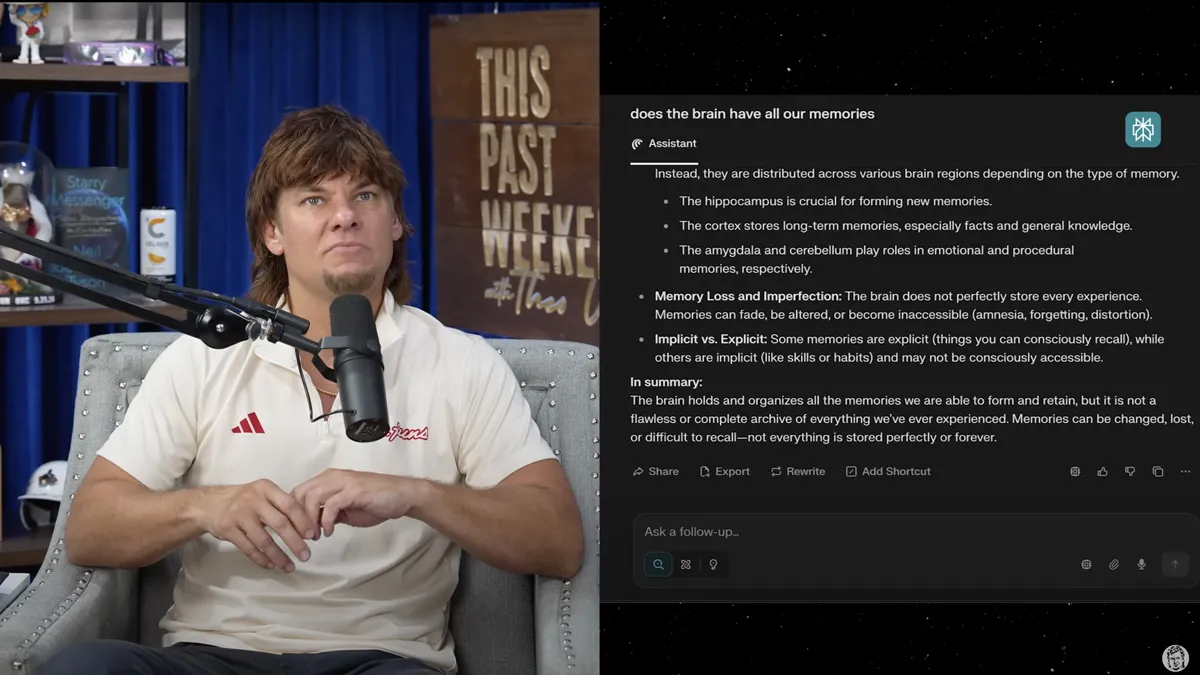
Reported from Ad Age, Perplexity has inked a new podcast advertising deal with Theo Von.
Explicit Salience
I’ve been obsessing lately over the idea of a “contextual brand”, one developed with a distinct understanding that it needs to make sense in a broad range of channels, situations and formats. And that making sense can be paired with some level of tailoring.
Brands have long relied on cultural context to connect. For example, LEGO works equally well in toys, pop culture, or comedy. But AI doesn’t understand nuance the way humans do.
To show up consistently, brands will need explicit salience: clear, on-record signals of what they stand for across every channel, without assuming shared cultural references. As a result, we need to vastly re-imagine how we build and communicate about brands in a reality where a human cultural understand is not a given.
After writing all of this, I asked Perplexity how they would market to AI. This is the response I got:
– Large Language Models prioritize resolution, not attention: Unlike humans, LLMs are not swayed by emotional appeals or flashy branding. They are designed to resolve user queries with accurate, relevant, and trustworthy information.
– Visibility is measured by Share of Model (SOM): This new metric assesses how often your brand is mentioned, the gap between human and AI awareness, and the sentiment associated with your brand in LLM outputs.
– Content must be structured and context-rich: LLMs draw from a wide range of sources—text, images, videos, reviews, and structured data. They favor content that is well-organized, factual, and directly addresses user needs or queries.
We’re going to need to figure out how to market to the LLMs, as much as we’re figuring out how to market with them. Nearly everyone I know in this industry is obsessing over the latter, and not thinking about the former at all. I’m starting to think that’ll be a determining factor in how the next decade goes.